Work Arrives To Your Desktop

This is your team's desktop with LivPro present in it. Work reaches them where they already are, not in a tool they have to remember to open. Recurring tasks start on their own, a process assigned by a colleague lands ready to action, and the day's insights arrive without anyone going to look for them. Whatever is already in flight stays visible in the Bucket, one click from where it was left, so nothing gets lost when attention moves on. Because LivPro is present at the desktop rather than another tab to open, the right next action is obvious and easy to start, without remembering, searching, or asking.

Persistent at the desktop

The LivPro Bucket and step modals sit alongside the applications your team already uses, always present and always to hand. There is no app to open and no context to switch into.

Work arrives to you

Recurring tasks auto-start on their schedule, assignments land on your desktop from a colleague part-way through a process, and the morning streak analysis arrives at the start of the day. Each one reaches you in context, at the point it is relevant.

Pick up where you left off

Your Bucket holds every workflow you have open, so you can see what is active and continue any of it in one click. Nothing slips because you got pulled onto something else. Your to-do list sits there too, so the smaller things stay in view.

Shaping How Execution Is Done

The step modal is what is shaping how execution happens, present at the desktop in the moment of execution. It carries the noise-reduced description of what to do and how to do it supported by your firm's senior expertise surfaced in the Tips section, the due date and reference documents in context. The team member sees only what they need for this step, not the full process, keeping focus on the immediate action.
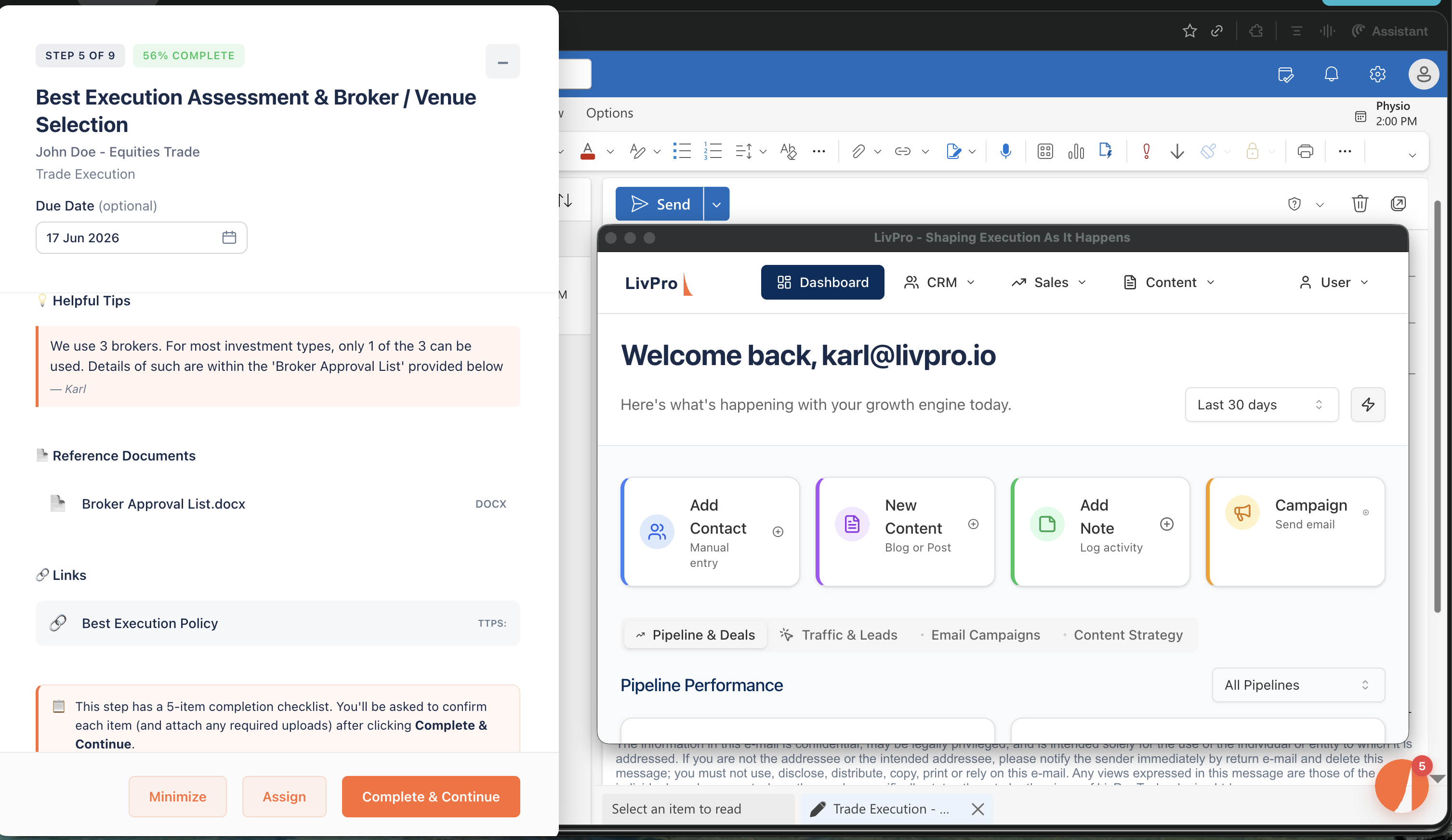
LivPro step modal showing the current step the team member is working on, with description, Tips section, due date, reference documents, and actions
“Solves execution drift across the team.”
“Solves senior expertise being locked in the most experienced people's heads.”

Present at the moment of execution

At the desktop, alongside their applications, exactly when execution is happening.

Multiple noise-reduction techniques embedded

Sequencing prevents step-skipping. Required checklists confirm completion. The correct documents and links surface in context. Instructions provide judgement criteria when needed.

Senior expertise surfaced in context

Your firm's most experienced operators contribute Tips that appear at the moment of execution.

Multi-Channel Feedback Captured Immediately

When you complete a step, a feedback form auto-pops up offering four distinct ways to surface feedback: a. process improvement ideas, b. peer Tips for future team members on the same step, c. case-specific context for the audit report, and d. PTA flags for complicated reviews. Each piece routes immediately to the process owner, making feedback live and actionable while the experience is still fresh. This is the qualitative insight that explains what execution data is showing and driving fast iteration loops in your firm's processes.

“Solves the same issues surfacing quarter after quarter.”

Four channels of feedback

Process improvement to process owners. Peer Tips into step modals. Case context to audit reports. PTA flags for review. Each serves a different substantive purpose.

Step-level granularity, captured fresh

Feedback is specific to the exact step where pain or insight was felt. When execution data shows Step 4 is slowest, the qualitative feedback on Step 4 explains why.

Routes live to the process owner

Every submission flows immediately to the process owner. Feedback is actionable the moment it lands, driving fast iteration loops in your firm.

Streaks Drive Consistent Execution

When you complete a process or recurring task, the team member's feedback shows up immediately. Company processes display a completion message with execution data such as duration, on-time status, and completeness. Recurring tasks show completion data plus streak analysis tracking consistent execution over time.
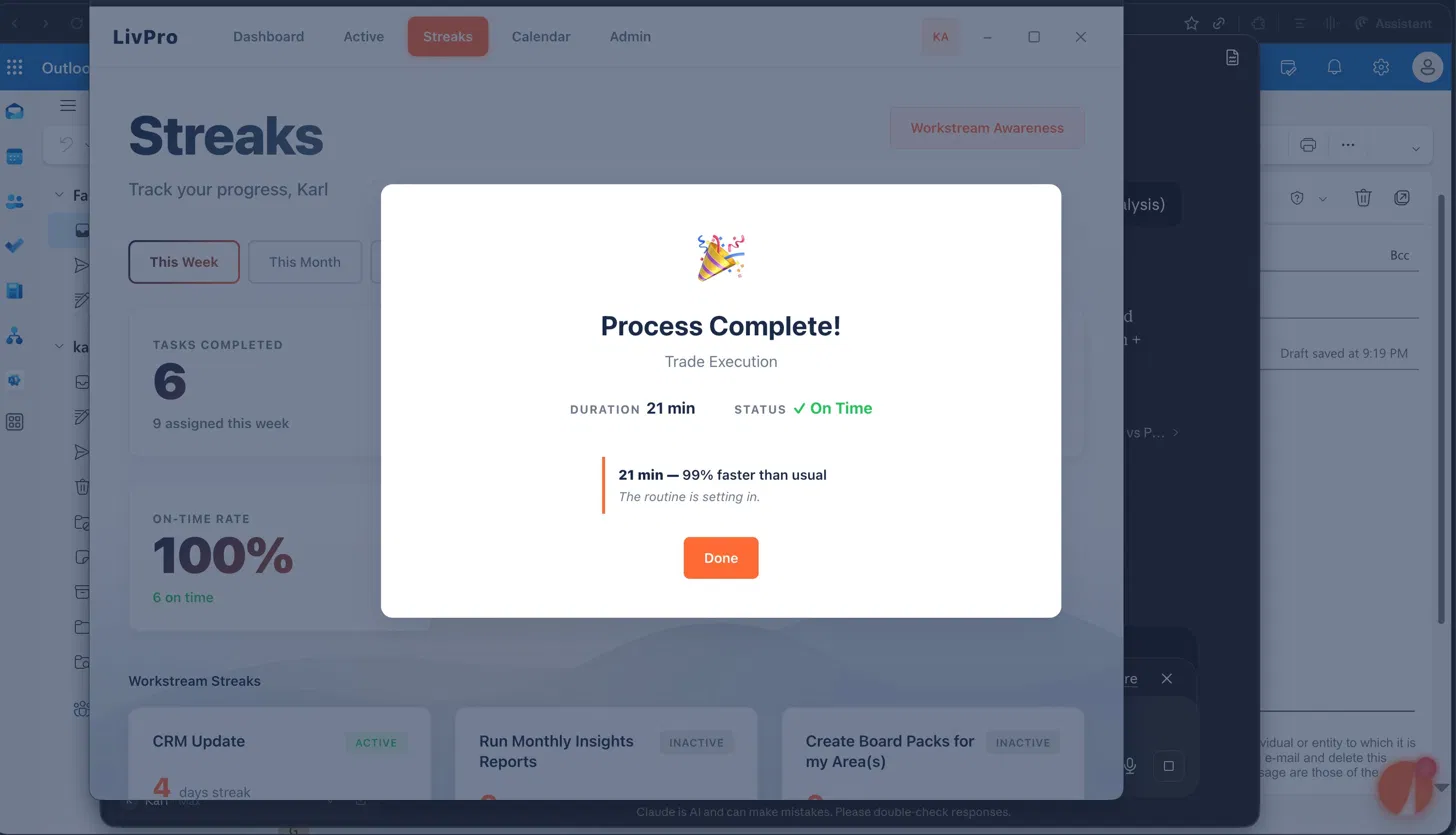
Process completion modal with execution data (duration, on-time status) appearing over the streak analysis dashboard showing consistent execution patterns

Process completion with execution data

When a company process is completed, the modal thanks the team member and surfaces the execution data: duration, on-time status, completeness.

Streak analysis at task completion

Recurring task completions show the streak analysis tracking consistent execution. Each completion adds to the visible compounding pattern.

Both drive consistent execution

Visible completion data and visible streak patterns build consistent execution into your team's working pattern over time.
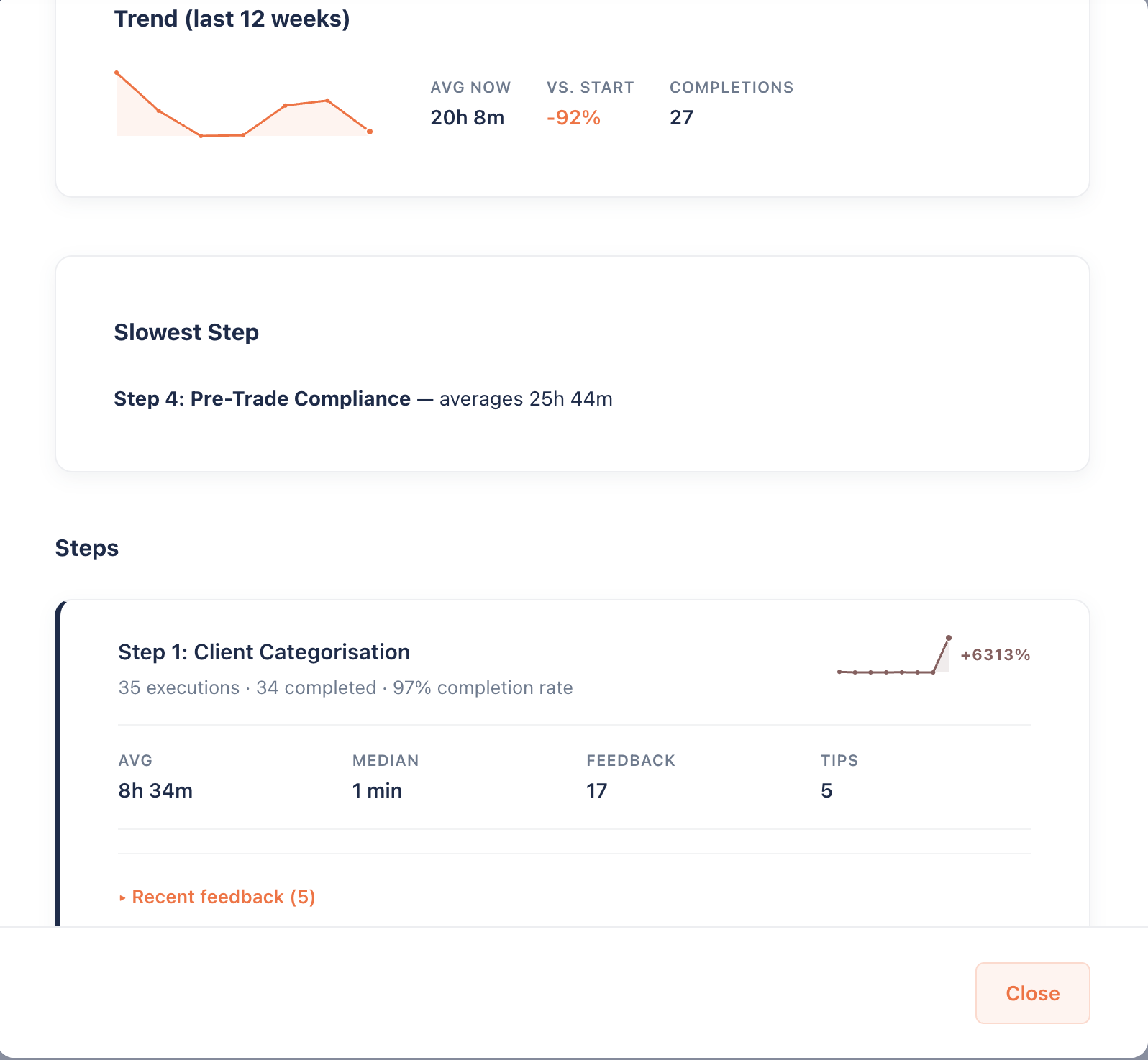
execution data
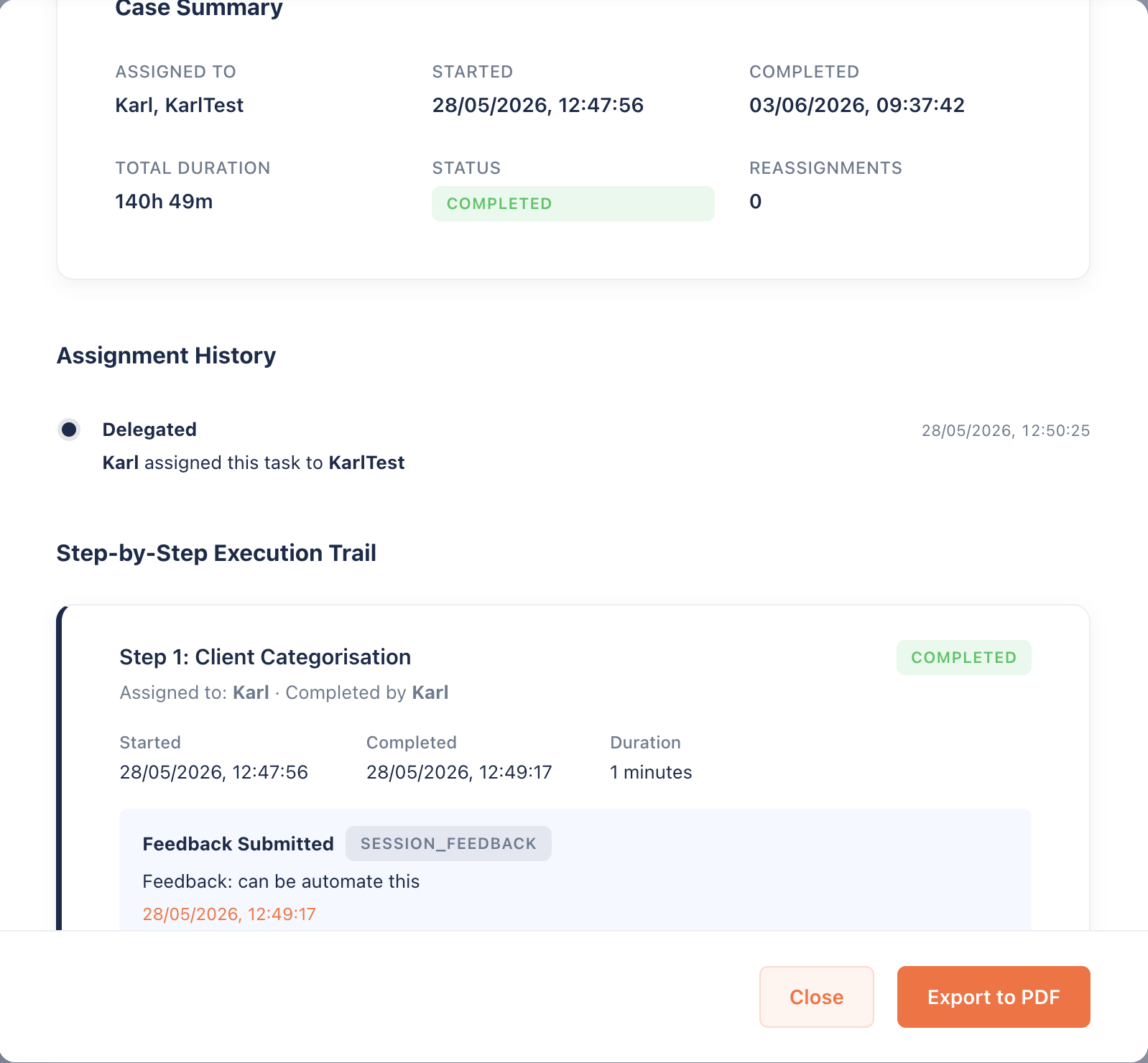
feedback

Your team's execution feeds your process loop

From here you run the loop on what they generated, reading the data, integrating the fixes, improving the process.

Analytics and Audit From Unique Data

Because LivPro operates at the time of execution, it captures unique quantitative and qualitative data. This execution data provides granular insights into process health and enables the automated generation of process audit reports.

Analytics
Best Execution Process
Live
Process Analytics
Audit Report
Best Execution Process Q4 · In Progress
Live
Audit Report
“Solves for wasted time and resources piecing compliance evidence together after the fact and from memory.”

Process data

For every process you track starts, completions, time metrics (average, median, fastest, slowest), on-time rate, and feedback activity. Drill to step level for per-step metrics, the slowest step highlighted, and the quarterly trend.

Combined with team information

Unique to LivPro because no other tool captures both quantitative and qualitative inputs at the time of execution. Process data combines with feedback, peer Tips, PTA flags, and other team channels into a single substrate.

Audit reports

The overview lists every team member involved, timing, duration, and finished status. Drill into each step for who completed it, start and end times, feedback, checklist timestamps, documents, and the assignment trail.

Analyse and Act: Quick Fixes or PTAs

Not every finding needs a meeting. The simple ones you fix at the source in seconds. The ones that do not, the recurring pain or the complex miss, are where guessing quietly keeps a broken process alive. For those you run a Post-Task Analysis. A team member can flag one from the feedback form as they work, and it arrives in your review to run or dismiss. From there LivPro gathers each participant's diagnosis independently, builds the pre-read, and guides the meeting to a root cause and a structural fix, not a vague "try harder."

“Solves slow iteration cycles.”
“Solves the same issues surfacing quarter after quarter.”

The right path for the finding

A simple issue, a wrong form or a broken link, is a quick fix at the source step, done in seconds. A complex or recurring one is escalated to a Post-Task Analysis. The PTA flags your team raised land in your review to run or dismiss, with the audit report one click away for context.

Independent diagnosis, then a guided review

Each participant answers the same diagnostic question independently, before anyone is in a room, so the outcome is not decided by the loudest voice. The question that decides it is whether the same task, run tomorrow on a similar case through the same process, would hit the same wall. That separates a broken process from a sound one let down in execution. LivPro builds the independent inputs into a pre-read and guides the meeting to the root cause.

Structural fixes only

A valid fix is a structural change. A new step, a changed rule, a new checklist item, a named training assignment. "Be more careful" and "remember to" do not count, and the review will not accept them. Every fix is logged against the PTA record as a concrete change.

Integrate and Disseminate

Integrating a change and rolling it out are the same act here. When you approve a Tip or fix a step at the source, one save is all it takes, and the team's next execution already has it. No change management, no retraining, no separate rollout. The loop that started with a team member's flag closes in real time.

“Solves slow iteration cycles while bringing the updates straight to the team to guide as they execute.”

Integration is dissemination

Approve a Tip or fix a step, for example swapping a wrong form for the right one, and the save at the source modal is the rollout. The team's very next execution runs the updated process, with nothing pushed, announced, or scheduled.

No separate rollout

The change lands without coordination calls, training sessions, or a document update chasing the process. What would normally be a managed rollout is just the next time someone runs the work.

Iteration speed compounds

Each cycle closes in moments instead of weeks. The slow improvement loop that lets bad process persist is gone, and over quarters that speed compounds into operational momentum a firm running traditional change cannot match.

Your team executes. The data substrate compounds. The iteration loop closes in real time.

That's how elite firms operate.